An Herbal Narrative
Taraxacum Officinale.
The magical herb, Dandelion, is poised to use it’s famous association as a “weed” to call into question how we engage with plants, both ideologically and in our day-to-day lives. The economic forces which benefit from keeping us in a battle against certain plants must face off against herbalogical history, science, ease, and flavor to keep their poisons flowing. As many still seek to remove dandelions form their yard, for purely aesthetic reasons, others are coming to see the dandelion as a collaborator in the quest for personal health, health for their land, and just simple snacking.
The story we’ve been sold is that dandelions reproduce fast, and if there’s one, your whole yard will soon be the bane of the neighborhood. It’s the perfect set up for herbicide companies to hook you, and every other self respecting lawn-tender, as a long-term, paying customer.
I’m a bit chagrined about anyone who poisons the Earth, but I’m not about to tell you what to do on your private property. I will, however, tell you some things about this magnificent specimen that may persuade you reconsider, and in case that doesn’t tickle the fly on the end of your nose, I’ll let you know some harmless, easy, and inexpensive ways to tell those little messengers of lasting health and well-being to “Get off (your) lawn!”.
I will assume that you too have taken a lazy moment in your youth to turn a dandelion over in your hand and study it a bit. I will further assume that you didn’t then know that you were participating in taraxology. Yes, the study of dandelions is so far reaching it has it’s own name. With a quick internet search on the matter you will begin to see why. The breadth of peer reviewed articles on medicinal applications alone show that this plant is an up and coming panacea. Furthermore, the recipes, gardening recommendations, notes on ecological benefits, artwork, and poetry show that our culture is finally remembering, and adding to, the reasons settlers brought this dear plant with them.
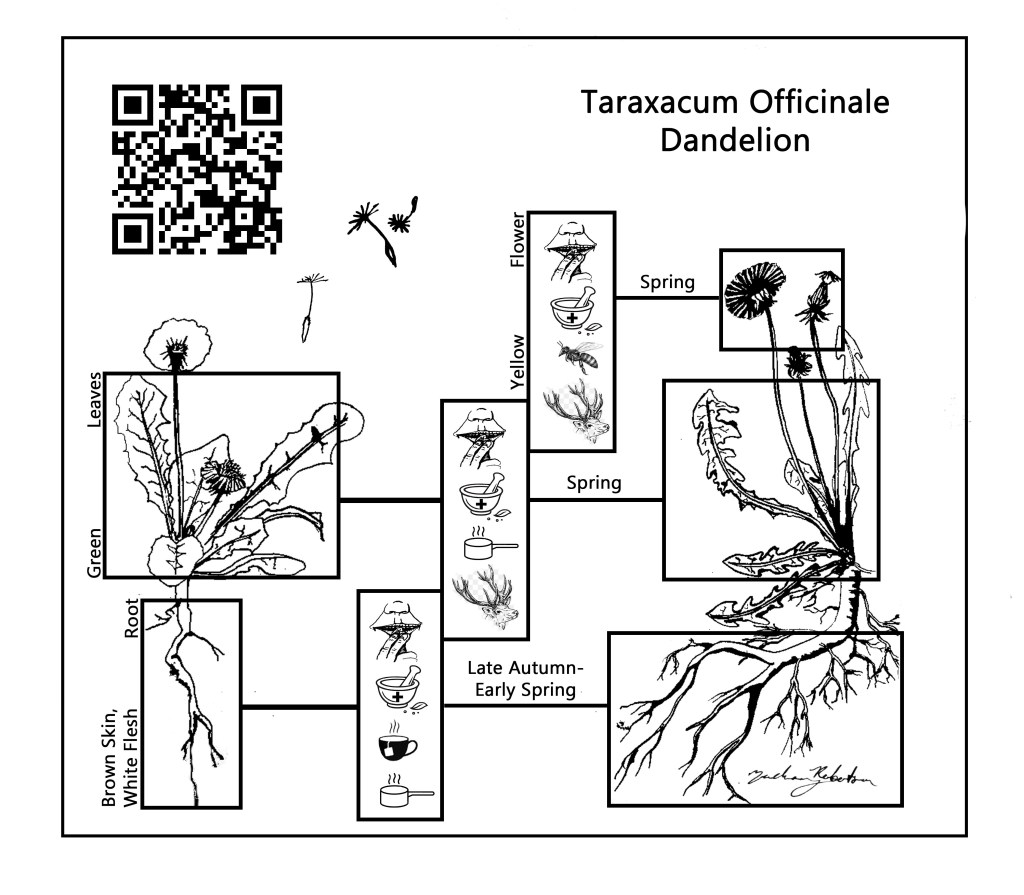
Their long-season-flowering is a godsend for bees and some butterflies, some birds make meals of dandelion seeds, and the greens are a welcome forage for deer and feral humans. Dandelion flowers, leaves, and roots are common ingredients in global cuisine. The leaves can be eaten raw (alone or in salad) or cooked the same way as spinach. The roots can be added to savory recipes or chopped, roasted, ground, and decocted as a nutritious coffee substitute or additive. The flowers are delicious raw, or battered and fried as fritters. They also impart a lovely flavor to fermented sugar water, in the case of dandelion wine.
Dandelion leaves, stems, and flowers are personally one of my favorite snacks on the go which is good because dandelions are nutritious. In short, they contain high amounts of potassium and other important minerals, proteins, fiber, and vitamins and a balanced combination of trace elements. Among purported benefits, they improve liver function, assist in regulating blood sugar, improve digestion, lower blood pressure, reduce cholesterol, reduce inflammation, reduce cancer risk, and boost the immune system Dandelions are something I am glad to eat every day. I start my walks hungry and reach my destination pleasantly filled and feeling great.
If you can welcome their smiling faces in your desert of green, dandelions are good for your lawn. Their tap roots draw nutrients, like calcium, from the subsoil to the surface, making them available for other plants. These same roots loosen hard packed soil, aerate the earth, and provide a channel for surface water to permeate, helping improve the land’s general biological capacity while reducing erosion and run off. I consider them a fine addition to nearly any landscape
If you have read this and still would like to rid your yard of dandelions, please do not use dangerous herbicides like Round-up. A spot application of distilled vinegar should do the trick, especially if some effort to remove a bit of the plant, possibly for a salad, is made ahead of time. It may be only a tale, but I’ve heard of a French village where every dandelion plant was eaten during a long famine of war. The story goes that the dandelion still has not returned.
While dandelion is both the poster-child of unwanted plants and increasingly seen as one of the healthiest, there is a third meaning dandelions have always held for us. We cannot look at a dandelion without being washed over with the feeling of childhood play and innocence. In this era of increasing tenuousity and challenge, this attribute may be the most important and far reaching. We soon may need the hope of blowing on a full soft silver crone ball of seeds for a wish, for a prayer, or for the propagation of tomorrow’s meals and medicine.
 Read Norma NormaL children's books!